Bataillon Rall
Chasseurs de l‘Armée, 1762
Landgraviate of Hesse-Cassel
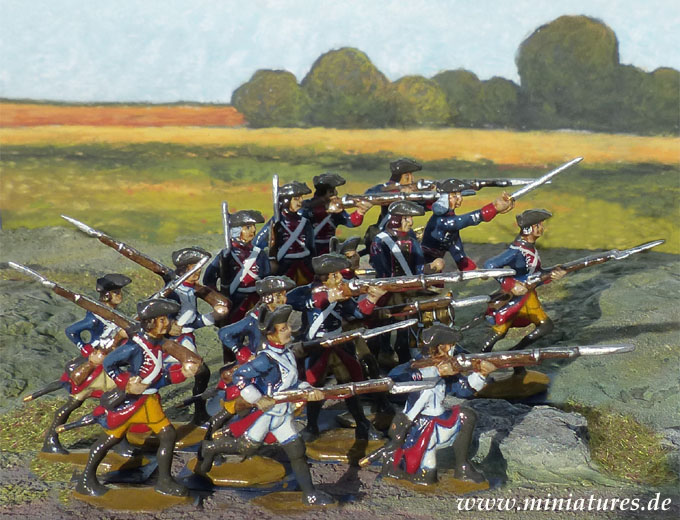
The landgravial Hesse-Cassel Battalion Rall of the Chasseurs de l‘Armée was one of four chasseur battalions raised for the 1762 campaign of the Allied army in western Germany. Ferdinand of Brunswick-Wolfenbüttel, commander-in-chief in the western theater of operations, urgently needed more light troops to hold his own in the petty warfare against the far stronger French army. The illustration shows Major Rall and the 1st Company of his battalion. These homecast 40 mm Prince August figures were painted with artist acrylics and they are individually mounted on ferromagnetic bases made of 0.2 mm sheet iron compatible with the Charge! game system.
According to Rudolf Witzel’s book “Hessen Kassels Regimenter in der Alliierten Armee 1762” [Hesse-Kassel’s Regiments in the Allied Army of 1762], the Rall Battalion of the Chasseurs de l‘Armée, raised in late May 1762, received 50 men each from the Hessian regiments of the 2nd Guard, 3rd Guard, Mansbach, Wutginau, Anhalt, Gilsa, Bischhausen, and Malsburg. Added to this were the required non-commissioned officers and officers, who were likewise detached from their regiments. One of those detached was Johann Gottlieb Rall; having served as a major and commander of the 4th Company of the von Bischhausen Infantry Regiment since May 7, 1760, he now became the commander of the Hesse-Cassel Chasseurs de l‘Armée. Duke Ferdinand was reportedly so pleased with the Chasseurs that, as early as June 1762, he granted them the distinction of being permitted to play the grenadier march of their respective nation. Only “reliable and good men” were to be selected for service with the Chasseurs, receiving special training for patrol duties and laying ambushes. Grenadiers replaced their conspicuous grenadier caps with tricorn hats, while the rank and file removed the lace from their hats and adopted cockades of green ribbon. Many officers followed suit to better blend in with their men and improve their camouflage. The Chasseurs constituted an elite force that stood clearly apart from Freitruppen and received their replacements promptly from the regular army.
Organization for Wargames
The following 1:10 scale organization is recommended for wargames using the Charge! game system by Brigadier Peter Young and Lieutenant Colonel James Philip Lawford. Here, the light infantry battalion consists of the battalion commander and a sergeant-major, along with two companies, each comprising an officer, an NCO, a musician, and twelve chasseurs. The pewter figures are distributed such that each of the eight Hesse-Kassel regiments is represented by four figures. Other simulation games, such as Charles Grant’s The War Game, employ light battalions of 24 or merely twelve figures, depending on the chosen scale.
- Major Johann Gottlieb Rall (IR Bischhausen, Nr. 4)
- Feldwebel (IR Mansbach, Nr. 8)
- 1. Kompanie
- Capitaine (2. Garde, Nr. 6)
- Unteroffizier (3. Garde, Nr. 1)
- Drummer or Bugler (IR Wutginau, Nr. 5)
- 3 Chasseurs (2. Garde, Nr. 6)
- 3 Chasseurs (3. Garde, Nr. 1)
- 3 Chasseurs (IR Mansbach, Nr. 8)
- 3 Chasseurs (IR Wutginau, Nr. 5)
- 2. Kompanie
- Capitaine (IR Malsburg, Nr. 10)
- Unteroffizier (IR Anhalt, Nr. 11)
- Drummer or Bugler (IR Gilsa, Nr. 3)
- 3 Chasseurs (IR Anhalt, Nr. 11)
- 3 Chasseurs (IR Gilsa, Nr. 3)
- 3 Chasseurs (IR Bischhausen, Nr. 4)
- 3 Chasseurs (IR Malsburg, Nr. 10)
The Hessian Chasseurs de l‘Armée were last attached to Luckner‘s Corps near Bingenheim on August 28, 1762; they occupied the posts along the Nidder, at Staten, Mockstadt, and Ober- and Niederdauerheim, after driving the enemy from them. The armistice was concluded on November 15, 1762, at Brücker Mühle near Amöneburg. In January 1763, shortly before the end of the war, Major Rall was transferred to Major General J. L. F. von Stein’s garrison regiment, where he was promoted to lieutenant colonel.
Bibliography
- Witzel, Rudolf: Hessen Kassels Regimenter in der Alliierten Armee 1762 (Norderstedt 2007)